
Why Naruto Was Nerfed in Boruto: The Real Reason
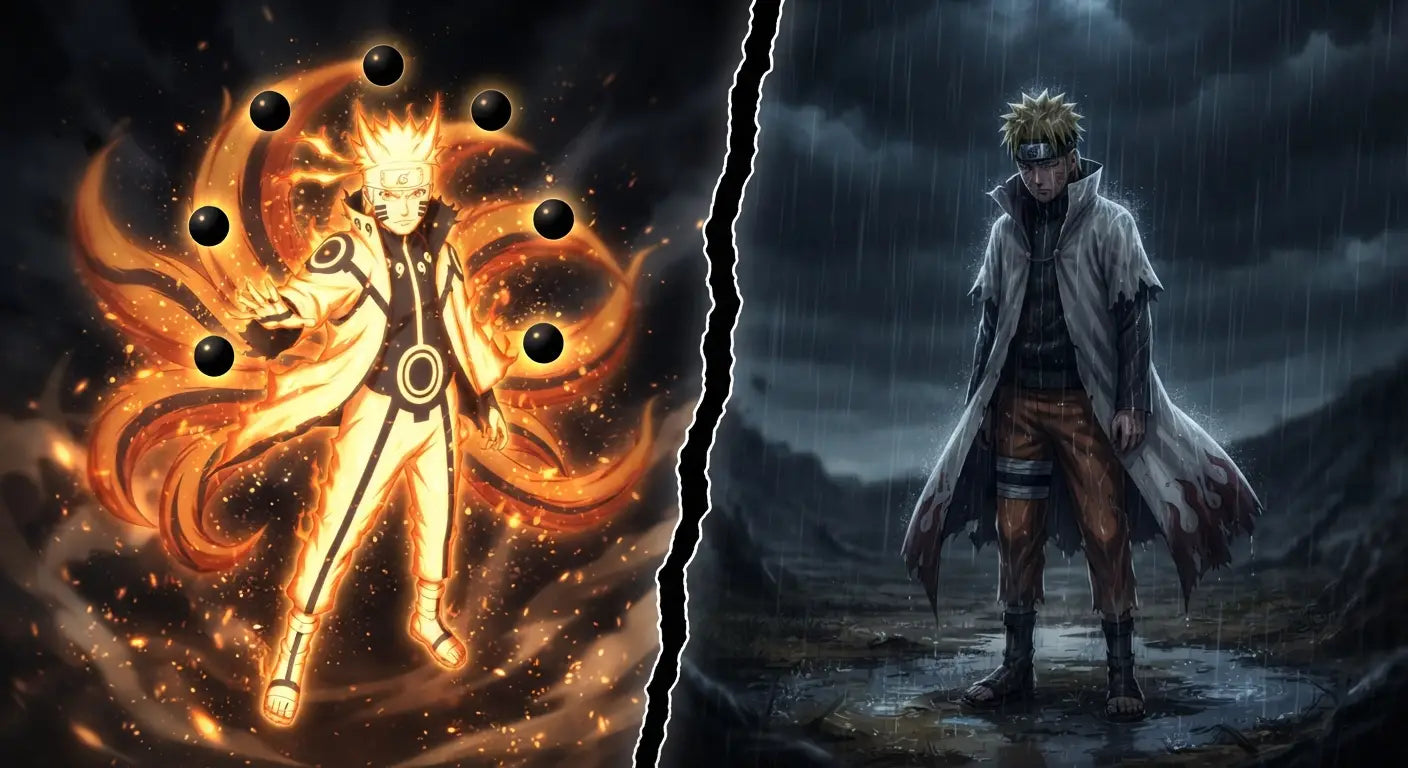
Thameemudheen Kachayi MankoolBy the conclusion of the Fourth Great Ninja War, Naruto Uzumaki had become something beyond a ninja. He could move at light speed, reshape battlefields with planet-scale attacks, absorb the chakra of nine tailed beasts simultaneously, and stand alongside Sasuke against a goddess who created entire dimensions on a whim. In practical terms, he was a demigod, and a young one at that.
So when fans sat down with Boruto: Naruto Next Generations and found this same character struggling against threats that a prior version of himself would have resolved in seconds, the backlash was swift and vocal. Across forums, Twitter threads, and YouTube essays, one word kept appearing: nerf.
Was it lazy writing? A necessary narrative sacrifice? Or something more complicated? The honest answer is all three, and understanding it requires looking at both what the story needed and what the production decisions actually delivered.
How Strong Was Naruto at His Absolute Peak?

To understand the scale of what changed, it helps to be precise about where Naruto actually stood at the end of Shippuden. After receiving power from Hagoromo Otsutsuki, the Sage of Six Paths, he unlocked a transformation that put him in a different category from any threat the series had previously introduced.
In Six Paths Sage Mode, Naruto could fly under his own power and generate Truth-Seeking Balls: orbs of chakra capable of negating any ninjutsu, including attacks from other divine-tier users. His link to all nine tailed beasts granted access to every elemental nature transformation, including rare kekkei genkai like Lava Style and Boil Release. Kurama's chakra reservoir was effectively bottomless: thousands of shadow clones, planetary-scale attacks, and prolonged attrition warfare were all viable simultaneously. Fatal wounds repaired themselves in seconds without slowing him down.
In practice, this meant Naruto and Sasuke could fight Kaguya Otsutsuki, a being who created and collapsed entire pocket dimensions, and hold their own. His final clash with Sasuke, who had absorbed chakra from eight of the nine tailed beasts, ended in a literal draw. This is the baseline from which Boruto departs. Establishing it clearly matters, because the gap between that version of Naruto and his Boruto counterpart is what drives the entire controversy.
The Narrative Case for the Perceived Nerf

The perceived weakening of Naruto in Boruto serves several distinct storytelling functions. Understanding them doesn't require agreeing with the execution, but it does reveal that the choices were intentional rather than accidental.
Passing the torch. Boruto is not a story about Naruto. If the previous generation's strongest shinobi can resolve every crisis in the opening arc, the new protagonists have no room to grow, fail, or matter. Generational sequels face this problem universally: legacy characters must be sidelined, constrained, or removed to create genuine stakes for the heroes who are supposed to carry the series.
Solving the escalation problem. By the end of Shippuden, power levels had reached an almost unsustainable ceiling. Battles involved characters threatening the moon and reshaping geography. Scaling new villains above that threshold while keeping fights tactically interesting was essentially impossible. Resetting the baseline allowed the series to return to what made early Naruto compelling: conflicts won through strategy, sacrifice, and ingenuity, not pure destructive output.
Thematic rebirth. Naruto's defining traits were never really his chakra; they were his willpower, his empathy, and his refusal to abandon people. A Hokage who leads through wisdom and sacrifice rather than godlike power is a more interesting figure for the next generation to eventually surpass. Stripping away the divine toolkit forces the character back to those roots.
Establishing new threats as credible. For Isshiki, Momoshiki, and Code to register as genuine dangers, the audience needs to believe those antagonists can hurt Naruto. His reduced capacity is partly a device to make new villains feel threatening before the reader recalibrates to the series' updated power ceiling.
The Kurama Factor: More Than a Stat Reduction

Of all the changes in Boruto, the loss of Kurama stands apart, and it deserves to be examined separately, because calling it a "nerf" undersells what actually happened architecturally.
Kurama's chakra leaked into Naruto's system constantly, even at baseline. This passive enhancement boosted his speed, durability, and striking power without him consciously activating any form. More critically, Kurama functioned as a biological support system: healing catastrophic injuries in seconds, filtering genjutsu automatically, and gathering natural energy on the fly so Naruto could enter Sage Mode without needing to stand still to meditate. The Nine-Tails also served as the bridge between Naruto and the other tailed beasts, the mechanism that made Six Paths Sage Mode's elemental diversity possible.
Without Kurama, Naruto loses all of this simultaneously. He can't sustain prolonged battles. He can't absorb the punishment that defined his fighting style. He can no longer gather natural energy passively, so Toad Sage Mode, his fallback, requires precious seconds of stillness in a combat environment where that's rarely possible. His shadow clone capacity, once practically unlimited, becomes genuinely constrained by a chakra reserve that, while still substantial by Uzumaki standards, is merely exceptional rather than borderless.
A traditional nerf lowers a character's numerical output while keeping their toolkit intact. What happened to Naruto was different: the removal of Kurama dismantled the architecture behind his entire adult fighting style. He isn't a weaker version of his Shippuden self; he is a structurally different fighter operating without the engine that made his modern approach viable.
Different Threats, or Inconsistent Writing?

One of the more substantive debates in the Boruto fandom is whether Naruto's struggles against new villains represent genuine power-scaling inconsistency or a misunderstanding of how high-level shonen combat actually works.
Consider Isshiki Otsutsuki, often cited as the villain who most convincingly broke the ceiling. Isshiki wins not through superior destructive output, but through Sukunahikona, the ability to instantly shrink himself or any non-living object to microscopic scale. Against this, Naruto's enormous chakra reserves offer almost no advantage. You cannot overpower what you cannot hit. Defensive fighting styles built around absorbing or deflecting force are useless against an opponent who can become invisible at will, collapse the ground beneath you, and summon full-sized objects from a pocket dimension at any moment.
This is a recurring pattern across the series. Kaguya's All-Killing Ash Bones bypass durability entirely with an insta-kill property. Madara's Limbo clones create attacks no one can perceive without the Rinnegan. Momoshiki's absorption ability means throwing more chakra at him literally makes him stronger. The most dangerous abilities in this world are rarely the ones that deal the most damage; they're the ones that make conventional defense irrelevant.
Utility frequently outweighs raw power at the highest tiers of shonen combat. Naruto and Sasuke don't lose to Isshiki because he has more chakra. They lose because his shrinking ability bypasses every form of traditional defense they have.
Baryon Mode, the form Naruto uses to counter Isshiki, is the writers' acknowledgment that no existing toolkit could solve that matchup. It's a single-use, existentially costly answer to a very specific problem, burning both Naruto's and Kurama's life forces as fuel. Whether that reads as compelling drama or a contrived workaround depends largely on how much trust the reader extends to the creative team at that point in the series.
Behind the Scenes: The Production Reality

Understanding Boruto's creative decisions requires knowing who is actually making them, because the answer is more complicated than it appears on the cover page.
The original Naruto manga was written and drawn entirely by Masashi Kishimoto. Boruto: Naruto Next Generations launched under writer Ukyō Kodachi and illustrator Mikio Ikemoto, with Kishimoto providing high-level oversight. Around Chapter 52, Kishimoto returned as the credited writer, but Ikemoto continues to drive core plotting and storyboards, with Kishimoto confirming publicly that Boruto is fundamentally Ikemoto's manga at this stage.
The transition to Boruto: Two Blue Vortex marked a deliberate aesthetic pivot: away from the slice-of-life ninja academy structure and toward a darker, higher-stakes sci-fi survival narrative. This creative handoff explains some of the scaling inconsistencies fans point to, particularly around Momoshiki, whose threat level has fluctuated noticeably between appearances. Different creative stewards have different intuitions about where characters sit relative to each other.
The anime adaptation has compounded this by introducing its own "anime canon" content that occasionally conflicts with manga details, creating ongoing debate over which medium holds definitive continuity. Minor discrepancies like character ages, rank details, and academy outfits have accumulated into a legitimately confusing picture for viewers who engage with both versions.
The Wider Debate: Necessary Evil or Failure of Craft?

Naruto is far from alone in this. The overpowered-protagonist problem appears across the shonen genre whenever a character reaches a power level that strains the story's ability to generate meaningful tension.
Goku in Dragon Ball Super is frequently cited as suffering from flanderization, a selective, inconsistent application of his abilities that makes him seem oblivious to tactics he demonstrated mastery of decades earlier, primarily to extend fights or justify new power-up forms. Monkey D. Luffy's stamina limitations following Gear Fifth have divided fans between those who see them as a logical cost of awakened power and those who read them as manufactured friction to keep antagonists viable longer. DC's Flash possesses speed that should resolve almost any conflict instantly, yet is written to hesitate or forget his own capabilities in nearly every major encounter. Pikachu resets to low power at the start of every new regional journey despite demonstrated strength in prior seasons, one of the clearest examples of a mandatory reset with no in-story justification.
There are two genuine perspectives on this pattern, and both have real merit. The first: some degree of power modulation is an unavoidable cost of longform serialized fiction. Once a character is established as capable of destroying planets, the story has two options: escalate continuously until it becomes absurd, or impose limits that keep the human drama in focus. The second: good writing doesn't require protagonists to suddenly become oblivious or forgetful. Well-crafted antagonists should win through specific counters and superior preparation, not because the writer decided the hero forgot a technique they used effortlessly a chapter prior.
The best version of Boruto's power-scaling argument falls in the first camp. Some of the series' weakest moments fall in the second. The gap between those two outcomes is largely a question of execution, which means it varies by arc, chapter, and which creative team was steering at the time.
Conclusion
Naruto's reduction in power was a narrative sacrifice made in service of a sequel that needed room to breathe. For Boruto to function as its own story, with its own heroes, its own stakes, its own emotional truth, the invincible safety net of the previous generation had to be moved out of reach. That's not a creative failure. It's the fundamental challenge every generational sequel faces.
The execution is legitimately uneven. The loss of Kurama was handled with genuine emotional weight, and the introduction of utility-based threats represents a thoughtful evolution of what power means in this world. But the creative transitions behind the scenes, the anime's divergences, and occasional lapses in scaling consistency have given critics fair and real ammunition.
What the controversy ultimately reflects is the depth of investment the audience carries into Boruto from Naruto Shippuden. A character built from nothing into something mythic over hundreds of chapters doesn't stop being mythic the moment a new title card appears. The frustration is real, but it's also, in its own way, a testament to how well the original story did its job.