
Ninjutsu in Naruto: Complete Guide
Thameemudheen Kachayi MankoolNinjutsu is the core shinobi discipline in the Naruto world, standing alongside Taijutsu and Genjutsu as one of the three pillars of combat. It's performed by using chakra to achieve feats far beyond normal human limits, and it's a major reason the series resonates with fans: the flashy hand signs, elemental manipulation, and sheer creativity behind each jutsu. Ninjutsu defines a ninja's power, their village's identity, their bloodline's legacy, and ultimately who ranks strongest. Techniques like the Rasengan take immense discipline to master, so anyone who wields one has clearly trained hard and earned that strength.
Ninjutsu also tracks character growth throughout the series. Think of Naruto mastering the Shadow Clone Jutsu or Kakashi developing the Lightning Blade. This guide covers everything you need to know about Ninjutsu: how chakra and hand seals work, the different types of jutsu, and who wields the best Ninjutsu in the series.
What Is Ninjutsu in Naruto?

Ninjutsu is the primary combat category in Naruto, a set of chakra-based techniques that manipulate energy, matter, and the physical world. Performing it means blending spiritual and physical energy into chakra, then shaping that chakra with precise hand seals. This lets a shinobi unleash elemental forces, create clones, or launch devastating attacks like the Rasengan, Fireball Jutsu, or Shadow Clone Jutsu.
There are three broad categories of jutsu. Ninjutsu is the most common, using chakra to produce effects beyond normal human ability. Taijutsu relies on raw physical strength without molding chakra at all. Genjutsu works differently still: it invades an opponent's mind and nervous system, using chakra to trap them in a sensory illusion.
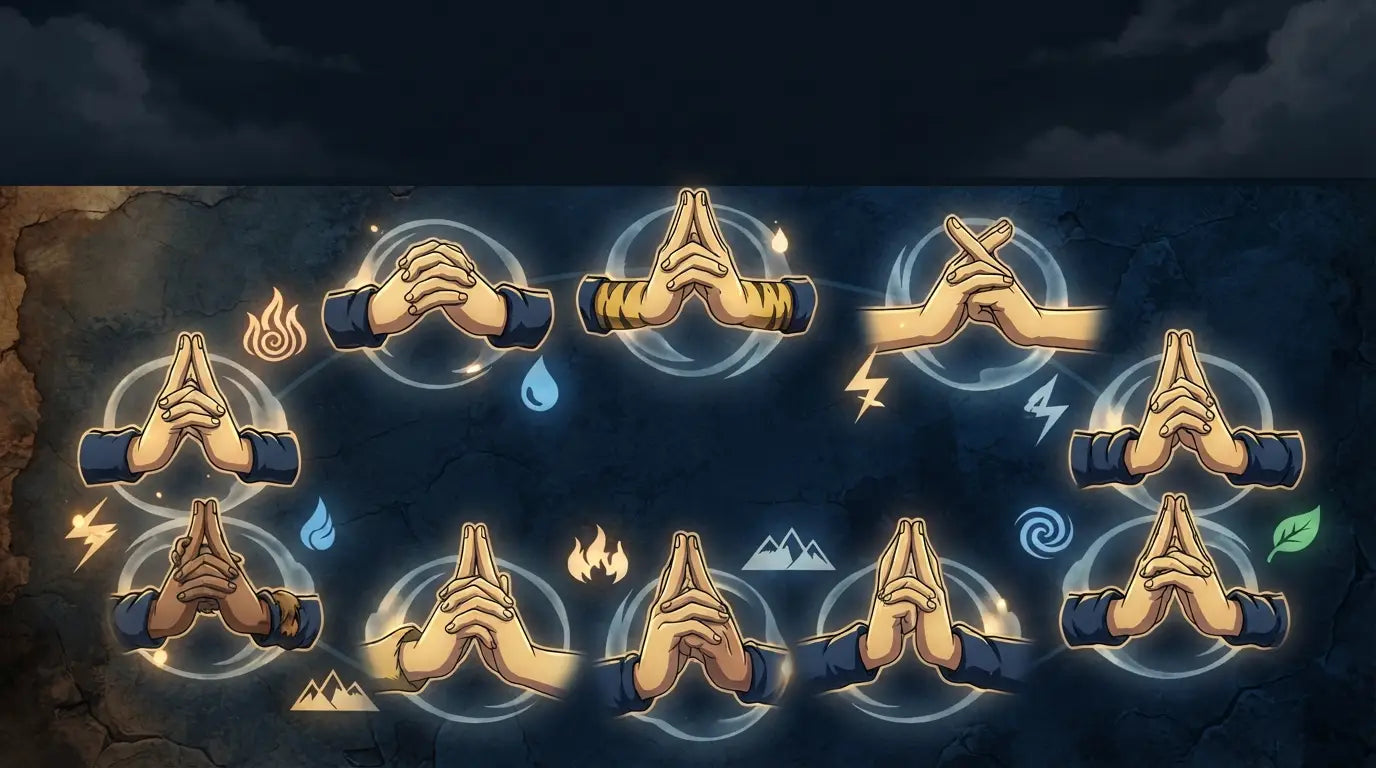
Chakra itself forms when physical and spiritual energy combine, and hand seals direct that chakra into a specific jutsu. Naruto's world recognizes five basic chakra elements: fire, wind, lightning, earth, and water. These form the foundation of all elemental ninjutsu, and they're significant enough that each of the five major shinobi nations is named after one.
How to "Do" Ninjutsu in Naruto (In-World Mechanics)

Chakra forms from two combined energies: physical energy, drawn from the trillions of cells in the body, and spiritual energy, built through experience, study, and training. Once combined, a shinobi channels this chakra and shapes it with hand movements to produce the jutsu they want.
Step-by-Step Mechanics of Ninjutsu
- Combining energies: Physical energy (from the body's cells) merges with spiritual energy (built through mental discipline, experience, and meditation) to create the life force known as chakra.
- Molding and routing chakra: Chakra travels through the body to the hands or feet, depending on the technique. Precision matters here. Too little energy and the jutsu fails, and too much can strain or even damage the user.
- Performing hand seals: Shinobi form specific hand gestures based on the twelve zodiac animals (Rat, Ox, Tiger, Hare, Dragon, Snake, Horse, Ram, Monkey, Bird, Dog, and Boar). These seals guide the chakra into the correct shape. Highly skilled ninja can shorten sequences or perform jutsu with a single hand sign for a faster attack.
- Release and execution: The shinobi infuses the chakra with an element (fire, lightning, and so on) until it takes physical form, like a fireball or a blade of lightning. Many ninja shout the technique's name as they release it.
Hand seals essentially act as a shortcut for guiding chakra into a specific elemental shape, and highly trained ninja can reduce or skip seals entirely once they've mastered fine control over their chakra output. Every shinobi discovers their natural affinity using special chakra-sensitive paper made from a unique tree: fire burns it, wind slices it in two, lightning causes it to crumble, water dampens it, and earth turns it to dirt. More advanced training pushes further: splitting a waterfall for water affinity, cutting a leaf clean in half for wind, or grinding stone to dust for earth.
Three training exercises are iconic in the series. Leaf concentration involves balancing a leaf on the forehead to build steady chakra control. Tree climbing means channeling chakra to the feet to walk vertically up a tree trunk. Water walking requires continuously adjusting bursts of chakra from the feet to stay balanced on a moving body of water.
There's also a clear line between skill levels. Academy-level jutsu, such as Transformation, Clone, and Substitution, are taught to every student as basic survival tools. Advanced, clan-specific techniques, like the Uchiha Fireball Jutsu or the Nara Shadow Imitation Technique, are far more restrictive, often requiring specific genetic traits and specialized chakra reserves passed down within a bloodline.
Who Has the Best Ninjutsu in Naruto?

Ranking ninjutsu in the Naruto world usually comes down to versatility, destructive power, tactical utility, and chakra efficiency. Here are some of the strongest contenders:
- Naruto Uzumaki: One of the most versatile ninjutsu users in the series, Naruto masters multiple Rasenshuriken variants, infusing them with different nature transformations and Six Paths Sage chakra.
- Minato Namikaze: Best known for the Flying Thunder God Technique (Hiraishin no Jutsu), a legendary space-time ninjutsu that lets him teleport instantly to any marked location, kunai, or person, earning him the nickname "The Yellow Flash of the Leaf."
- Itachi Uchiha: His signature ninjutsu is Susanoo, especially when paired with its sacred weapons, the Totsuka Blade and the Yata Mirror. (Techniques like Tsukuyomi and Izanami are arguably his strongest overall abilities, but they're classified as Genjutsu, not Ninjutsu.)
- Sasuke Uchiha: His most powerful ninjutsu spans space-time teleportation, massive elemental constructs, and divine-level sealing techniques, blending the Rinnegan, Mangekyo Sharingan, and Sage of Six Paths chakra into devastating attacks.
- Madara Uchiha: Known for Limbo: Border Jail, a technique using invisible, dimension-shifting clones. He can also summon massive meteors with Tengai Shinsei and unleash the Majestic Destroyer Flame, a fire blast so large it takes an army of water-style users to counter it.
- Obito Uchiha: Uses Kamui to send parts of his body, or entire objects, into another dimension. He can also unleash the Fire Release: Blast Wave Wild Dance, a massive spinning spiral of fire, and fire sharp Wood Release spikes from his own body.
- Kakashi Hatake: His strongest technique is Kamui Raikiri, combining Six Paths chakra with Dual Mangekyō Sharingan to warp a target on contact, powerful enough to pierce high-tier threats like Kaguya. His signature standard techniques remain the Raikiri (Lightning Cutter) and Purple Electricity.
Notable Clan Specialists
Three clans stand out as ninjutsu specialists. The Uchiha Clan is famous for powerful Fire Style and dojutsu abilities like the Sharingan and Rinnegan. The Senju Clan is known for massive chakra reserves, healing abilities, and Wood Style. The Uzumaki Clan is recognized for its extraordinary life force, enormous chakra pools, and sealing techniques.
Fans often debate whether Naruto's raw chakra and Rasengan mastery outweigh Sasuke's more calculated Rinnegan techniques, though many consider Minato the most tactically brilliant thanks to his teleportation. Madara, meanwhile, is widely regarded as the peak of traditional, terrifying ninjutsu power.
How Many Ninjutsu Are There in Naruto?

Fan-run archives like Narutopedia and Fandom Wiki document somewhere between 2,500 and 2,600 unique techniques. Broadly, ninjutsu falls into two categories: elemental releases, such as Fire (Katon), Water (Suiton), Wind (Fūton), Earth (Doton), and Lightning (Raiton), which combine into advanced Kekkei Genkai like Wood, Ice, Lava, and Dust Release; and non-elemental styles, including Medical Ninjutsu, Space-Time Ninjutsu (teleportation), and Fūinjutsu (sealing techniques).
Pinning down an exact count is genuinely difficult. Anime-only filler, game-exclusive jutsu, unnamed or one-off variants, and the sheer volume of techniques introduced across the franchise all make a precise number elusive. Some jutsu appear only once or twice in the entire series, while entire game franchises have invented stylized techniques that never appear in the original manga. Most fans treat the Official Narutopedia Jutsu archive as the closest thing to a definitive source.
Setting aside techniques tied to bloodlines or god-tier power, Wind Release: Rasenshuriken is generally considered the hardest jutsu to master organically.
Criteria for Jutsu Difficulty
Technique difficulty is typically measured on a standard E-rank to S-rank scale, based on a few key factors:
- Chakra control and cost: How precisely the user must shape chakra without wasting it
- Hand seals: How long and complex the sequence is (the Water Dragon Jutsu, for example, requires 44 seals)
- Physical and mental strain: How much the technique taxes the user's body or mind
Notoriously difficult examples:
|
Ninjutsu |
Rank |
Primary Difficulty Source |
|
Rasenshuriken |
S-Rank |
Requires simultaneous, maximum Shape and Nature Transformation, a feat both Minato and Kakashi once considered impossible. |
|
Edo Tensei (Imperfect Resurrection) |
S-Rank |
Requires DNA harvesting, a living human sacrifice, and the mental fortitude to continually suppress the souls of the resurrected. |
|
Reaper Death Seal (Shiki Fūjin) |
S-Rank |
A sealing ritual that traps the target's soul while permanently costing the user their own life force. |
Some techniques are considered so dangerous that they're forbidden outright. These are classified as Kinjutsu (Forbidden Techniques) because they cause severe self-harm, require human sacrifice, or defy the natural order by trading a life to manipulate death.
What's the Hardest Ninjutsu to Learn in Naruto?

In terms of pure learning difficulty, Wind Release: Rasenshuriken tops the list because it demands a near-impossible combination of Shape and Nature Transformation happening at once. When it comes to techniques that are hardest to perform at all, Particle Style (Jinton) and Wood Release stand out, both requiring specific genetics or bloodline traits that can't be trained into existence.
Wood Release is a prime example: it combines Earth and Water chakra natures simultaneously, and outside of Hashirama Senju, who could use it naturally, every other user has relied on artificially implanted cells. Particle Style (Jinton), a byproduct of the Kekkei Tōta bloodline, combines three natures at once (Earth, Wind, and Fire) into three-dimensional matter, a feat mastered by only two shinobi in the series' history.
Even techniques without a genetic requirement can take years to master. Naruto spent thousands of hours developing the Rasengan, using shadow clones to compress wind chakra through sheer repetition. The Flying Thunder God (Hiraishin), created by Tobirama and later perfected by Minato, demands flawless calculation, instant reaction time, and near-perfect chakra precision.
Some techniques simply can't be learned without the right genetics. Kekkei Genkai hardwire a user's cellular pathways to process dual or triple nature transformations natively, and forcing that ability onto an incompatible body, such as through Hashirama cell implants, often results in fatal rejection or severe physical mutation.
What Is the Most Powerful Ninjutsu in Naruto?

Ranked by sheer destruction, strategic value, and rarity, these are some of the most powerful techniques in the series:
- Infinite Tsukuyomi: Widely considered one of the most powerful techniques in the series, a genjutsu-ninjutsu hybrid cast from the moon that traps all of humanity in a shared dream world.
- Six Paths: Ultra-Big Ball Rasenshuriken: Naruto's Kurama Avatar form combines nature energy with tailed-beast power to launch two massive, nature-infused projectiles.
- Indra's Arrow: Sasuke's strongest attack, channeling chakra from all nine tailed beasts into a single lightning-infused bow and arrow.
- Expansive Truth-Seeking Ball: Kaguya's ultimate technique, using the God Tree to absorb chakra from every living person and reduce the world to dust.
Fans often place Kaguya's Expansive Truth-Seeking Ball at the absolute peak of pure creation and destruction, while Infinite Tsukuyomi ranks highest for scale, since it affects every person on the planet simultaneously. Fans focused on straightforward combat power tend to favor Naruto and Sasuke's final battle at the Valley of the End as the pinnacle of active battle ninjutsu.
Is Naruto Ninjutsu Copyrighted?
The broad concept of ninjutsu and general ninja folklore is public domain, but the specific fictional elements, visual designs, and naming conventions created for the Naruto franchise by Masashi Kishimoto and Shueisha are protected intellectual property. Shueisha and Studio Pierrot, along with global licensors like Bandai Namco, hold commercial rights to the franchise's specific assets, scripts, art, and audio-visual content. Names like "Naruto" and its official logo are registered trademarks.
Most rights holders tolerate non-commercial fan fiction and fan art, though it technically exists in a legal gray area rather than being formally licensed. Creating original ninja characters inspired by general anime tropes or broad concepts like elemental magic is legal, since those ideas aren't owned by anyone.
Note: This is general information, not legal advice. For specific IP concerns, consult a qualified professional.
Conclusion
Ninjutsu sits at the heart of Naruto's entire power system, and it's one of the clearest windows into how each character grows, since every new technique represents another step in that journey. Built from chakra and hand seals, it lets characters achieve feats that would otherwise be impossible: shadow clones, elemental attacks, and space-bending teleportation. Its popularity comes down to that same creativity: flashy elemental powers, distinctive hand signs, and inventive tactical fights that keep fans coming back. Decades later, the Rasengan and Shadow Clone Jutsu remain two of the most iconic techniques in the entire series.